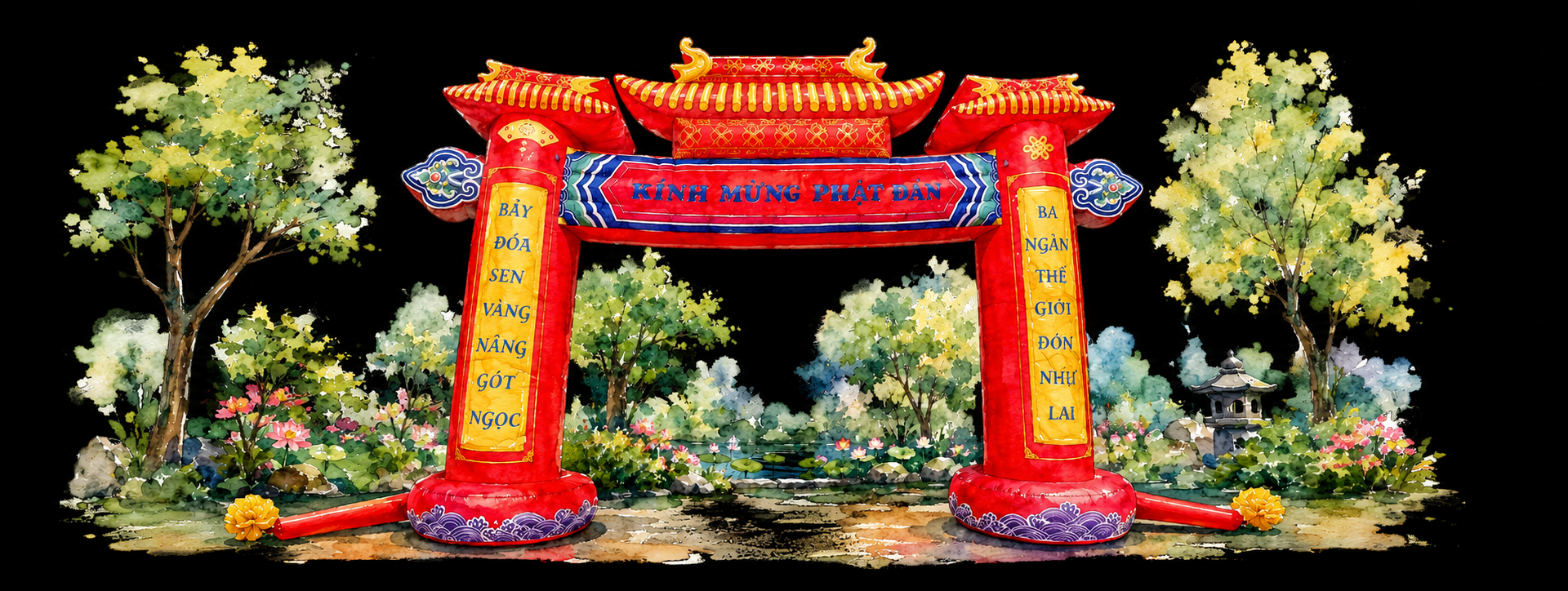
Trong bối cảnh sinh hoạt Phật giáo Việt Nam tại hải ngoại, đặc biệt tại Hoa Kỳ trong những năm gần đây, chúng ta ngày càng chứng kiến nhiều lễ hội Phật giáo, lễ đài Phật Đản, không gian trang trí hay các công trình mang hình thức “chùa Việt” được tổ chức với quy mô lớn và đầu tư công phu hơn trước. Đó trước hết là một tín hiệu đáng quý, phản ánh nỗ lực gìn giữ đời sống tâm linh và văn hóa dân tộc giữa cộng đồng lưu xứ. Tuy nhiên, cũng chính trong dòng phát triển ấy, một vấn đề âm thầm bắt đầu xuất hiện, mỹ học Phật giáo Việt Nam đang dần đứng trước nguy cơ bị méo mó bởi xu hướng thị giác hóa và trình diễn hóa không gian tâm linh.
Chỉ trong vài thập niên ngắn ngủi, chúng ta chứng kiến ngày càng nhiều hình thức được dựng lên nhân danh “Phật giáo Việt Nam” nhưng lại xa dần tinh thần mỹ học và đạo học vốn từng nuôi dưỡng tâm thức dân tộc suốt hàng trăm năm lịch sử. Điều đáng nói hơn, sự lệch lạc ấy đang diễn ra âm thầm đến mức nhiều người trong chúng ta bắt đầu không còn phân biệt được đâu là khí vị đích thực của mỹ học Phật giáo Việt Nam, đâu chỉ là những hình thức tâm linh bị sân khấu hóa và thị giác hóa theo xu hướng của thời đại.
Đây không phải câu chuyện bài Hoa hay chống giao thoa văn hóa. Lịch sử Phật giáo Việt Nam chưa bao giờ tồn tại trong cô lập. Từ thời Lý–Trần, văn hóa Việt đã tiếp nhận ảnh hưởng từ Ấn Độ, Trung Hoa rồi chuyển hóa thành bản sắc riêng. Nhưng điều khác biệt nằm ở chỗ Thầy Tổ cà Cha Ông chúng ta tiếp nhận để Việt hóa, còn ngày nay nhiều nơi lại sao chép để phô diễn. Một bên là quá trình hấp thụ để tạo nên căn tính. Một bên là quá trình vay mượn để tạo hiệu ứng thị giác.
Chính ở đây, câu hỏi không còn đơn thuần là chuyện mỹ thuật nói chung, kiến trúc hay trang trí nói riêng mà trở thành vấn đề của mỹ học Phật giáo và nhận thức đạo học.
Mỹ học Phật giáo Việt Nam, tự căn để không phát triển trên tinh thần áp đảo con người. Nó không hướng đến việc khiến người bước vào phải “choáng ngợp” trước quyền uy của hình khối hay sự đồ sộ của công trình. Trái lại, vẻ đẹp của chùa Việt cổ thường nằm ở sự thấp, mềm, lùi vào thiên nhiên, nép bên ao sen, sân gạch hay mái đình làng. Người bước vào chùa Việt không có cảm giác đi vào một “đế chế tâm linh”, mà giống như đi vào một khoảng lặng của quê hương.
Nhìn vào Chùa Tây Phương, Chùa Keo hay Chùa Bút Tháp, điều còn đọng lại không phải sự hùng vĩ kiểu cung điện mà là một vẻ trầm mặc rất Việt Nam. Mái ngói không dựng đứng dữ dội mà cong mềm như nhịp thở. Hiên sâu để tránh nắng mưa nhiệt đới. Kèo gỗ, sân gạch, hồ nước, cây thị, tiếng chuông chiều… tất cả tạo nên một không gian khiến con người tự nhiên nói nhỏ lại, bước chậm lại và lòng cũng lắng xuống.
Trong khi đó, nhiều mô hình mỹ thuật Phật giáo hiện nay lại đang bị kéo dần về phía trình diễn thị giác. Không khó để bắt gặp những chiếc “tam quan” thực chất mang hình tượng thành quách Minh–Thanh hay mô phỏng Vạn Lý Trường Thành, màu đỏ son và mái vàng kim. Người đi vào lọt thỏm giữa không gian như bước vào một công viên chủ đề cổ trang hơn là đi vào một nơi tu tập.
Đó không còn là khí vị của mỹ học Phật giáo Việt Nam nữa.
Tam quan Việt vốn không phải cổng thành. Nó là cửa chuyển tâm thức. Ba cửa tượng trưng cho Không môn, Vô tướng môn và Vô tác môn. Vì vậy tam quan Việt cổ thường có tỷ lệ gần với con người, nhẹ, sâu và có chiều thiền. Tam quan không nhằm thị uy mà mở ra một khoảng chuyển tiếp từ cõi động vào cõi tĩnh.
Sự khác biệt này thực ra không đơn thuần chỉ là khác biệt hình thức mà là khác biệt trong triết lý về con người và cách cảm thụ đạo.
Tinh thần Phật giáo Việt Nam, đặc biệt từ truyền thống thiền phái Trúc Lâm và văn hóa làng xã, luôn tránh thần quyền hóa không gian. Vì vậy, mỹ học Phật giáo Việt Nam luôn có tính tiết chế rất mạnh. Nó không thích phô diễn quá mức. Nó hiểu rằng vẻ đẹp tâm linh không nằm ở sự nặng nề của vật chất mà ở khả năng làm cho tâm con người an xuống.
Điều đáng lo ngại nhất không nằm ở chuyện vay mượn hay giao thoa văn hóa — vì lịch sử Phật giáo Đông Á vốn luôn có sự tiếp biến qua lại mà nằm ở chỗ khi sự tiện lợi, thương mại hóa và tâm lý “làm cho nhanh, cho hoành tráng” dần thay thế chiều sâu văn hóa, chúng ta rất dễ đánh mất phẩm giá của không gian Phật giáo. Và một khi phẩm giá ấy mất đi, hệ lụy không chỉ dừng ở kiến trúc hay mỹ thuật mà còn âm thầm dẫn đến những sai lệch trong nhận thức đạo học lẫn mỹ học Phật giáo của nhiều thế hệ.
Chùa chiền, tam quan, pháp khí hay tượng Phật chưa bao giờ chỉ là vật trang trí. Trong truyền thống Phật giáo Việt Nam, mỗi đường mái, mỗi khoảng sân, mỗi tiếng chuông, mỗi màu ngói đều mang chức năng giáo dục tâm thức. Kiến trúc không đơn thuần để “đẹp” nhưng để giúp con người lắng xuống, biết nhỏ lại trước vô thường, biết quay về với sự giản dị và tỉnh thức.
Vì vậy, khi không gian Phật giáo bị sân khấu hóa và thị giác hóa theo xu hướng thời đại, con người cũng dễ tiếp cận Phật giáo bằng tâm lý tiêu thụ hình ảnh hơn là hành trì nội tâm. Người ta đi chùa để “thấy lớn”, “thấy đẹp”, “thấy lạ” hơn là để lắng lại trước vô thường. Một công trình có thể khiến khách tham dự lễ hội trầm trồ nhưng lại không còn khả năng nuôi dưỡng chiều sâu thiền tính của cộng đồng quanh nó.
Điều nguy hiểm hơn là sự lệch ấy nếu kéo dài sẽ tạo nên một lớp nhận thức mới, nơi người trẻ tưởng rằng càng to lớn, càng rực rỡ, càng cầu kỳ thì càng “Phật giáo truyền thống”. Trong khi mỹ học Phật giáo Việt Nam đích thực lại nằm ở sự tiết chế, nhân hậu, gần gũi và khả năng làm cho tâm người an xuống. Một mái chùa Việt cổ có thể không đồ sộ, nhưng đủ sức giữ lại hồn dân tộc qua hàng trăm năm binh lửa. Một tam quan Việt đúng nghĩa không nhằm thị uy nhưng mở ra một lối đi từ cõi động bước vào cõi tĩnh của nội tâm.
Đó chính là lý do vì sao việc giữ gìn mỹ học và mỹ thuật Phật giáo Việt Nam không phải là thái độ bảo thủ hay khước từ giao lưu văn hóa. Đó là bảo vệ một hệ cảm thức đã gắn liền với đạo lý dân tộc. Bảo vệ khả năng để không gian tâm linh tiếp tục giáo dục con người bằng sự giản dị, khiêm cung và tỉnh thức. Và sâu hơn nữa, đó là bảo vệ quyền được nhận diện chính mình của văn hóa Việt Nam trong thời đại toàn cầu hóa.
Một dân tộc có thể tiếp nhận mọi ảnh hưởng văn hóa nhưng nếu đánh mất khả năng nhận ra khí vị thẩm mỹ của chính mình, thì sự mất mát ấy không còn chỉ là chuyện mỹ thuật mà là dấu hiệu của một ký ức văn hóa đang dần phai lạt. Và khi ký ức ấy mất đi, điều bị lung lay không những là mỹ học mà còn là khả năng cảm thụ đúng đắn tinh thần Phật giáo Việt Nam của cả một thế hệ tương lai.
Và sau cùng, xin được thưa thêm một điều với tất cả lòng khiêm cung và lòng kính trọng đối với chư Tôn đức cùng quý đạo hữu đã phát tâm thực hiện những mô hình như thế này trong các lễ hội Phật giáo hay mùa Phật Đản nơi hải ngoại. Những dòng nhận định trên hoàn toàn không xuất phát từ tâm ý bài xích hay thất lễ với bất kỳ truyền thống cá nhân hay công trình nào. Bởi trong mọi hoàn cảnh, điều đáng quý nhất vẫn luôn là tấm lòng hướng về Đức Phật và mong muốn làm cho ngày Khánh Đản trở nên trang nghiêm, rực rỡ giữa đời sống tha hương nhiều thiếu thốn.
Tuy nhiên, cũng chính vì lòng trân quý ấy mà đôi khi người viết cảm thấy cần phải thỉnh đạt một nỗi ưu tư rất chân thành, rằng mỹ học và mỹ thuật Phật giáo Việt Nam, dù được vận dụng thiện xảo hay sáng tạo đến đâu, vẫn nên giữ được khí vị riêng của đạo học và văn hóa dân tộc, để cái đẹp không bị đẩy đến chỗ méo lệch khỏi tinh thần thanh tịnh và tỉnh thức vốn là cốt lõi của cửa thiền. Bởi có những lúc, một hình tượng quá nặng về trình diễn thị giác lại vô tình làm phai đi sự lặng lẽ, tiết chế và chiều sâu nội tâm mà mỹ học Phật giáo Việt Nam từ bao đời nay vẫn âm thầm gìn giữ.
Thật ra, cửa vào cõi Phật chưa bao giờ nằm ở sự đồ sộ của vật liệu hay sự cầu kỳ của hình thức. Một mái hiên nhỏ, một cành sen, một tiếng chuông, một khoảng sân thanh tịnh… đôi khi đã đủ mở ra cả một thế giới nội tâm sâu thẳm. Trong tinh thần ấy, nếu không thể giữ được vẻ đẹp đúng nghĩa của mỹ học Phật giáo Việt Nam, thì đôi khi sự giản dị, tiết chế, thậm chí “không dựng gì cả”, lại vẫn gần với tinh thần Phật giáo hơn là dựng lên những hình tượng khiến mỹ thuật Phật giáo dần xa khỏi căn tính văn hóa và chiều sâu đạo học vốn có.
Bởi suy cho cùng, cửa Không vẫn là cửa đến của cõi Phật. Và nhiều khi, chính sự lặng lẽ, khiêm hạ và không phô trương ấy mới là thứ còn giữ được lâu bền nhất phẩm giá của mỹ học Phật giáo Việt Nam giữa một thời đại mà mọi không gian tâm linh đều rất dễ bị cuốn vào nhu cầu nhanh, tiện, phô diễn và thị giác hóa.
Nam Mô Hoan Hỷ Tạng Bồ Tát Ma Ha Tát
Phật lịch 2570 – Yuma, AZ 22.05.2026
LÔI AM
Vietnamese Buddhist Aesthetics — A Sanctuary for the Soul of a Nation
Within the context of Vietnamese Buddhist life overseas, particularly in the United States in recent years, we have increasingly witnessed large-scale Buddhist festivals, Vesak celebrations, ceremonial stages, decorative spaces, and various constructions presented under the image of a “Vietnamese temple.” On one level, this is a deeply encouraging sign, reflecting the sincere effort to preserve spiritual life and cultural identity within diaspora communities. Yet precisely within this growth, a quieter concern has begun to emerge: Vietnamese Buddhist aesthetics are gradually facing the risk of distortion under the pressures of visual spectacle and performative spirituality.
In only a few short decades, more and more forms have appeared in the name of “Vietnamese Buddhism,” yet many have drifted increasingly far from the aesthetic and spiritual sensibilities that once nourished the Vietnamese soul for centuries. More troubling still, this deviation has unfolded so subtly that many among us are beginning to lose the ability to distinguish between the authentic spirit of Vietnamese Buddhist aesthetics and forms of spirituality that have been theatricalized and visually stylized according to the tastes of the age.
This is not a matter of hostility toward Chinese culture nor a rejection of cultural exchange. Vietnamese Buddhism has never existed in isolation. Since the Ly–Tran dynasties, Vietnamese culture absorbed influences from India and China, then transformed them into something distinctly Vietnamese. The crucial difference, however, is that our teachers, ancestors, and forebears received outside influences in order to Vietnamese-ize them, whereas today many places merely replicate forms for the sake of visual effect. One process sought cultural integration and identity; the other often seeks spectacle and sensory impact.
At this point, the question is no longer simply about architecture, decoration, or artistic style. It becomes a question of Buddhist aesthetics itself, and of how the Dharma is inwardly perceived and understood.
At its root, Vietnamese Buddhist aesthetics did not develop from a desire to overwhelm human beings. It was never intended to leave visitors awestruck by monumental scale or imposing structures. On the contrary, the beauty of traditional Vietnamese temples often lies in their modesty, softness, and quiet integration with nature — nestled beside lotus ponds, brick courtyards, village communal houses, or ancient trees. One does not enter a Vietnamese temple with the feeling of stepping into a “spiritual empire,” but rather into a still and intimate corner of the homeland.
Looking at places such as Chùa Tây Phương, Chùa Keo, or Chùa Bút Tháp, what lingers in memory is not imperial grandeur but a profoundly Vietnamese quietness. The rooflines do not thrust upward aggressively but curve gently like breathing itself. Deep eaves shelter against tropical rain and sunlight. Wooden beams, brick courtyards, ponds, old village trees, and evening bells together create a space where people naturally lower their voices, slow their steps, and feel their hearts become calmer.
Meanwhile, many contemporary forms of Buddhist visual culture are gradually being drawn toward spectacle-oriented presentation. It is no longer difficult to encounter “temple gates” that in reality resemble stylized Ming–Qing fortresses or evoke imagery akin to the Great Wall, with vivid vermilion tones and gleaming golden roofs. People passing through such spaces often feel less as though they are entering a place of contemplation and practice, and more as though they are stepping into a historical-themed cultural attraction or theatrical set.
That is no longer the spirit of Vietnamese Buddhist aesthetics.
The traditional Vietnamese tam quan was never meant to resemble a fortress gate. It was a threshold of spiritual transition. Its three entrances symbolize the Gates of Emptiness, Signlessness, and Wishlessness. For this reason, traditional Vietnamese temple gates are human in scale, light in feeling, inward in depth, and contemplative in atmosphere. They were never designed to assert dominance, but to guide the human mind from movement into stillness.
This difference is therefore not merely a matter of outward form. It reflects a deeper difference in philosophical vision and in the way spirituality itself is experienced.
Vietnamese Buddhism — especially through the Truc Lam Zen tradition and the spiritual culture of the Vietnamese village — has consistently resisted the sacralization of power and the domination of space. Vietnamese Buddhist aesthetics possess a strong sense of restraint. They do not seek excess or ostentation. They understand that spiritual beauty does not reside in material heaviness, but in the ability to calm and settle the human heart.
The greatest concern, then, is not cultural borrowing itself — for East Asian Buddhism has always evolved through mutual exchange — but the fact that convenience, commercialization, and the mentality of “faster, bigger, more impressive” are gradually replacing cultural depth. Once that happens, the dignity of Buddhist space is easily lost. And when that dignity disappears, the consequences extend far beyond architecture or visual art; they quietly distort both Buddhist understanding and aesthetic perception across generations.
Temples, ceremonial gates, ritual objects, and Buddha statues were never intended as mere decoration. Within Vietnamese Buddhist tradition, every roofline, every courtyard, every bell, every color carried a pedagogical and spiritual function. Architecture was never simply meant to be “beautiful,” but to help people quiet themselves, recognize impermanence, and return to simplicity and mindfulness.
Thus, when Buddhist spaces become theatricalized and visually stylized according to contemporary trends, people also begin approaching Buddhism through the consumption of imagery rather than through inner cultivation. They go to temples to “see something grand,” “beautiful,” or “spectacular,” rather than to contemplate impermanence. A structure may amaze festival visitors, yet no longer possess the ability to nourish the contemplative depth of the surrounding community.
Even more dangerously, if such distortions continue long enough, they create a new layer of perception in which younger generations begin believing that the larger, brighter, more ornate, and more elaborate something appears, the more “traditionally Buddhist” it must be. Yet authentic Vietnamese Buddhist aesthetics reside instead in restraint, compassion, intimacy, and the ability to bring peace to the human heart. A traditional Vietnamese temple may not be monumental, yet it can preserve the soul of a people through centuries of upheaval. A true Vietnamese tam quan does not intimidate; it opens a passageway from the turbulence of the world into the stillness of the inner self.
This is precisely why preserving Vietnamese Buddhist aesthetics and artistic sensibility is not an act of conservatism nor a rejection of cultural exchange. It is the preservation of an entire spiritual sensibility inseparable from the moral and cultural foundations of the Vietnamese people. It is the preservation of spaces capable of educating human beings through simplicity, humility, and mindfulness. More profoundly still, it is the preservation of a people’s ability to recognize themselves within an age of globalization.
A nation may receive influences from every civilization. But if it loses the ability to recognize the aesthetic spirit of its own tradition, then the loss is no longer merely artistic — it becomes the fading of cultural memory itself. And when that memory fades, what becomes unstable is not only aesthetic perception, but also the ability of future generations to properly encounter and understand the true spirit of Vietnamese Buddhism.
And finally, allow me to offer one more thought with utmost humility and respect toward the venerable monastics and devoted lay Buddhists who have sincerely contributed their effort and goodwill to creating these forms within Buddhist festivals and Vesak celebrations overseas. These reflections do not arise from hostility, disrespect, or criticism toward any individual, tradition, or project. In every circumstance, what remains most precious is the sincere aspiration to honor the Buddha and to make Vesak beautiful and dignified amidst the many hardships of diaspora life.
Yet precisely because of that reverence, one sometimes feels compelled to voice a quiet and heartfelt concern: that Vietnamese Buddhist aesthetics and artistic expression — however skillfully adapted or creatively developed — should still preserve the distinctive spirit of Vietnamese Buddhist culture and Dharma, so that beauty does not become distorted away from the serenity and mindfulness that lie at the heart of the Buddhist path. For there are times when forms overly dependent upon visual spectacle unintentionally erode the silence, restraint, and contemplative depth that Vietnamese Buddhist aesthetics have quietly safeguarded for generations.
In truth, the entrance into the Buddha’s realm has never depended upon monumental materials or elaborate display. A modest roof, a lotus branch, the sound of a bell, a quiet courtyard — sometimes these alone are enough to open an entire world of inward stillness. In that spirit, if authentic Vietnamese Buddhist aesthetics cannot be preserved, then simplicity, restraint, or even “building nothing at all” may still remain closer to the essence of Buddhism than constructing forms that gradually estrange Buddhist art from its own cultural roots and spiritual depth.
For ultimately, the Gate of Emptiness remains the gateway to the Buddha’s realm. And often, it is precisely this quietness, humility, and absence of display that preserves most enduringly the dignity of Vietnamese Buddhist aesthetics in an age where sacred spaces are increasingly swept into the demands of speed, convenience, spectacle, and visual consumption.
Homage to the Bodhisattva of the Treasury of Joyful Delight, Mahāsattva.
Buddhist Era 2570 – Yuma, Arizona – May 22, 2026
LOI AM
 Uyên Nguyên